top of page
dhamma lotus-logo-chat-png.jpg


THE FUTURE JOURNEY OF THE DHAMMA LOTUS MOVEMENT:


The Future Journey of the Dhamma Lotus Movement

A Five-Stage Path Forward

The revival of Dhamma was not the end of a struggle — it was the beginning of a new moral era. The Dhamma Lotus Movement now carries that responsibility forward, guided by the emancipatory vision of Dr. Babasaheb Ambedkar.

Our journey unfolds in five powerful stages:


1️⃣ Awakening — Reclaiming the Moral Core


We begin by returning to the ethical heart of Dhamma: equality, rationality, compassion, and self-respect.

Through study circles, public dialogues, youth forums, and women-led initiatives, we reignite clarity about why the revival happened — and why it still matters.

This stage is about consciousness.

A movement rises first in the mind.


2️⃣ Healing — Restoring Inner Strength


Centuries of exclusion leave invisible, deep wounds.

Dhamma offers not only healing. But courage to overcome and move on.

We create safe spaces for mental resilience, ethical reflection, and collective dignity.

Through education, community support, and leadership development, we transform inherited suffering into disciplined strength.

This stage is about confidence.

A movement grows when people rediscover their worth.


3️⃣ Uniting — Building a Shared Platform

​​​


Fragmentation weakens purpose.

Dhamma Lotus serves as a neutral bridge — bringing together Ambedkarite Buddhist organizations without erasing their identities.

We foster cooperation over competition, dialogue over distrust, and coordination over isolation.

This stage is about solidarity.

A movement becomes powerful when it stands together.

4️⃣ Serving — Making Dhamma Visible in Action


Dhamma must be lived, not only proclaimed.

We expand educational initiatives, women’s empowerment programs, youth mentorship, constitutional awareness campaigns, and social service networks.

Ethics become action.

Compassion becomes policy.

Unity becomes an impact.

This stage is about credibility.

A movement earns respect through service.

5️⃣ Leading — Becoming a Model for the Oppressed


The final stage is not dominance — it is an example.

Dhamma Lotus envisions a united  Ambedkarite Buddhist community that inspires all marginalized communities across India. A living demonstration that oppression can be transformed through organized wisdom, moral courage, and disciplined unity.

This stage is about legacy.

A movement fulfills its destiny when it becomes a guiding light.

The Dhamma Lotus is not a moment.

It is a journey — from awakening to leadership.

And that journey begins with each one of us.

WE RISE TOGETHER.


Our Movement Principles & Code of Conduct

1. Principle of Equal Human Worth

Code of Conduct

➤ Treat every person with dignity, regardless of caste, gender, class, religion, language, or belief
➤ Disrespect, humiliation, or demeaning behavior is unacceptable
 

ii . Principle of Truth & Moral Courage

Code of Conduct

➤Speak truthfully, responsibly, and fearlessly
 

➤Do not spread misinformation, hatred, or deliberate distortion. 

iii. Principle of Compassionate Firmness

Code of Conduct

➤Stand firmly against injustice without cruelty or vengeance
 

➤Reject violence, threats, and dehumanization
 

iv. Principle of Constitutional Morality

Code of Conduct

➤Uphold liberty, equality, justice, and fraternity in all activities
➤No justification of discrimination in cultural or traditional terms.

v. Principle of Continuous Self-Correction

Code of Conduct

➤Acknowledge mistakes openly
➤Be willing to learn, unlearn, and transform.

A just movement must evolve. Dhamma guides our values.
The Constitution grounds our rights.
This is how we rise—together.  

Awakening.jpg
healing.jpg
Uniting.jpg
Serving.jpg
Leading.jpg
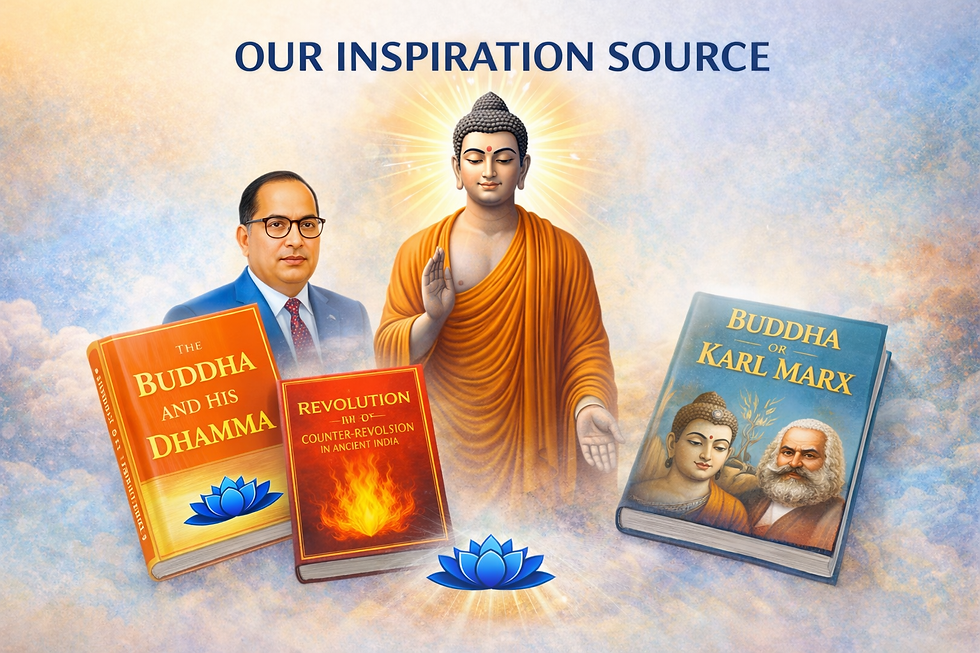
OUR INSPIRATION-BL.png
Dhamma as Ethical Revolution: An Integrated Reading of Dr. Babasaheb Ambedkar’s Three Foundational Texts: 

Dr. Babasaheb  Ambedkar’s intellectual engagement with Buddhism can be most clearly understood through an integrated reading of three major works: The Buddha and His Dhamma, Revolution and Counter-Revolution in Ancient India, and Buddha or Karl Marx. Though distinct in genre—religious reconstruction, historical analysis, and comparative political philosophy—these texts collectively articulate Babasaheb Ambedkar’s vision of Dhamma as a comprehensive ethical, social, and political revolution for the moral foundation for a modern, democratic, and egalitarian society.
I. Reconstructing the Buddha: Ethical Rationalism and Social Morality
In The Buddha and His Dhamma,  Dr. Babasaheb Ambedkar does not merely narrate the life of the Buddha; he reconstructs it through a modernist and rationalist lens. Rejecting supernaturalism, metaphysical speculation, and ritualism, he presents the Buddha as an ethical teacher concerned primarily with the reconstruction of society. For Ambedkar, the Buddha’s Dhamma is not a path of renunciation in the narrow ascetic sense but a moral framework designed to address human suffering rooted in, not just individual but also social conditions.
Central to Babasaheb Ambedkar’s interpretation is the idea that morality precedes metaphysics. The Buddha’s teaching emphasizes  prajñā (critical reason), karuṇā (compassion), and samatā (equality). Dhamma becomes a normative system governing social relations rather than an otherworldly doctrine concerned with salvation beyond history. By foregrounding liberty, equality, and fraternity—values he also inscribed into the Indian Constitution— Babasaheb Ambedkar positions Buddhism as inherently democratic. Thus, The Buddha and His Dhamma establishes the ethical foundation of his project: Dhamma as moral social order grounded in reason and justice.
II. Buddhism as Historical Revolution
If The Buddha and His Dhamma provides the normative core, Revolution and Counter-Revolution in Ancient India situates Buddhism within a broader socio-historical struggle. Here Babasaheb Ambedkar advances a bold historiographical thesis: ancient Indian history is best understood as a mortal conflict between two opposing social visions—the egalitarian revolution initiated by the Buddha and the hierarchical counter-revolution of Brahmanism.
Babasaheb Ambedkar interprets Buddhism as a radical social movement that challenged priestly monopoly, ritual authority, and caste stratification of the society. The Sangha, organized on principles of equality and ethical discipline, embodied an alternative social order. The decline of Buddhism, in his reading, was not merely religious but political—the triumph of Brahminism (ideology of Brahmin supremacy) over Buddha’s  moral democracy.
This historical framing transforms Buddhism from a purely spiritual tradition into a revolutionary social force. Ambedkar’s analysis thus links Dhamma as not only a personal code of conduct; it is a framework for reorganizing society. The counter-revolution represents the reassertion of graded inequality, while the Buddhist revolution symbolizes moral universalism and social mobility. Through this lens, Babasaheb Ambedkar states his own twentieth-century struggle against caste as a continuation of an unfinished historical revolution and  simultaneously warns to be vigilant about seeping counter-revolution.
III. Buddhism and Marxism: Convergences and Divergences
In Buddha or Karl Marx, Babasaheb  Ambedkar turns to modern political theory, comparing Buddhism with Marxism as two responses to exploitation and suffering. He acknowledges the moral urgency in Marx’s critique of economic injustice and class domination. Both the Buddha and Marx diagnose suffering as rooted in structural conditions rather than divine fate. Both advocate transformation of society rather than passive acceptance.
However, Babasaheb Ambedkar ultimately argues that the methods and moral foundations of Marxism are flawed. Marxism, grounded in materialist determinism and class struggle, legitimizes coercion and violence as instruments of historical change. Buddhism, by contrast, seeks transformation through ethical cultivation, persuasion, and democratic restructuring. For Babasaheb Ambedkar, ends cannot be separated from means: a just society cannot emerge from unjust methods.
This comparative study clarifies Ambedkar’s distinctive position. He does not reject structural reform; rather, he insists that social revolution must be anchored in moral and democratic principles. Buddhism offers a path of social justice not merely of economic redistribution but of the transformation of consciousness and social relations. Thus, while Marxism emphasizes material conditions, Buddhism integrates ethical self-transformation with institutional change.
IV. The Coherent Vision: Dhamma as Social Democracy
Taken together, these three works reveal a unified intellectual trajectory. The synthesis of these dimensions culminates in Babasaheb Ambedkar’s formulation of “ Dhamma”—a reinterpretation of Buddhism suited to modern democratic society.
Babasaheb Ambedkar’s Dhamma is neither traditionalist nor purely spiritual. It is civic, rational, and transformative. It rejects caste hierarchy, fatalism, and ritual orthodoxy, while affirming constitutional morality, social equality, and human fraternity. In this sense, Dhamma becomes the moral grammar of democracy.
Conclusion
The interrelationship of these three works demonstrates that Ambedkar’s engagement with Buddhism was neither devotional nor merely symbolic. It was philosophical, historical, and political. By reconstructing the Buddha, reinterpreting Indian history, and engaging modern socialist thought, Babasaheb  Ambedkar articulated Dhamma as an ethical revolution capable of addressing both spiritual alienation and social injustice.
In this integrated framework, Dhamma becomes a living force—an instrument for constructing a society based on liberty, equality, and fraternity. It is not only a path to personal awakening but a blueprint for collective emancipation.

.
bottom of page